

Water Damage Restoration FAQ
by Rapid Dry Moisture Recovery Services
Central Texas water damage answers backed by IICRC standards and real on-site experience.
Need immediate help? Call 254-218-3757 for 24/7 emergency response.
Serving Belton, Temple, Killeen, Harker Heights, Salado & all of Bell County.
The page covers:
• What to do when water damage happens
• Drying times & equipment questions
• Hidden moisture detection
• Carpet, walls, and flooring removal
• Insurance and FEMA answers
• Storm and flood cleanup
• Preventing mold after a water loss
Got questions about water damage?
You’re not alone. Rapid Dry Moisture Recovery Services answers the most common questions Central Texas homeowners have about leaks, flooding, and restoration—so you know exactly what to expect before, during, and after the job.
What is water damage restoration?
Water damage restoration is the process of extracting water, drying building materials, sanitizing contaminated areas, and documenting the loss for insurance. Rapid Dry follows IICRC S500 standards and provides 24/7 emergency water removal in Belton, Temple, Killeen, and surrounding Central Texas areas.
Learn More About Water Damage Restoration
What types of water damage are there?
The IICRC defines three categories of water:
Category 1 – Clean Water: From sanitary sources like burst pipes or supply lines.
Category 2 – Gray Water: Moderately contaminated water from dishwashers, washing machines, or toilet tank overflows.
Category 3 – Black Water: Heavily contaminated water such as sewage backups, floodwater, or storm runoff.
Correct category determines safety protocols, material removal, and sanitation requirements.
How fast should I respond to water damage?
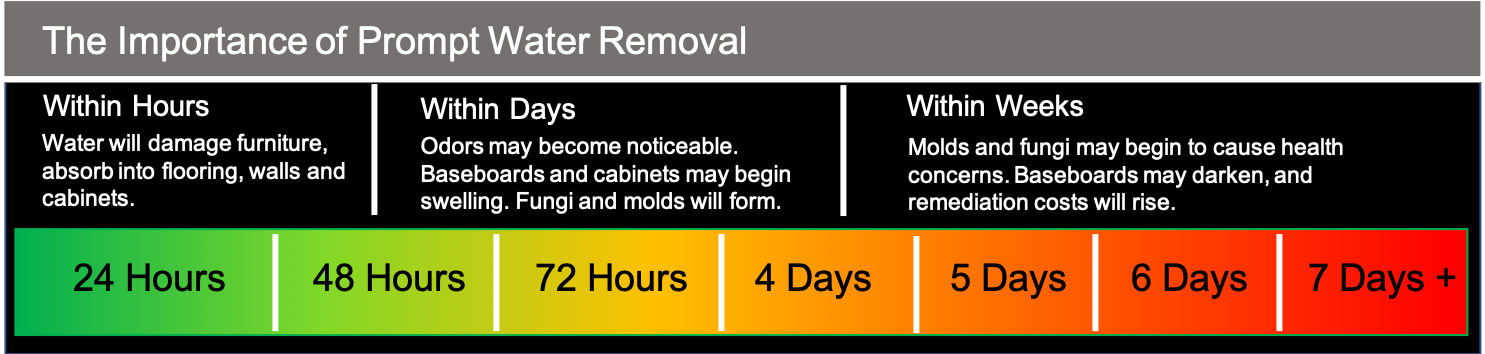
Immediately. Materials begin absorbing water within minutes, and mold can begin forming in 24–48 hours. Fast action prevents structural damage, swelling, cupping, and category upgrades.
Call 254-218-3757 for rapid response.
Is water damage restoration covered by insurance?
Most policies cover sudden and accidental water damage such as pipe bursts, water-heater failures, or slab leaks. Long-term leaks, slow drips, and neglected damage are typically not covered.
Rapid Dry handles photos, moisture logs, Xactimate estimates, and direct adjuster communication so you don’t have to.
Learn More About Understanding Your Insurance Policy
How much does water damage restoration cost?
Costs depend on the size of the affected area, water category, and materials involved.
Typical ranges:
• Extraction only: $300–$1,200
• Full dry-outs: $1,500–$6,000+
• Major flood losses: $10,000+ depending on severity
We bill insurance directly when possible to reduce out-of-pocket costs.
How long does drying take?
Most homes dry in 3–5 days, depending on the building materials, time water has been present, and indoor humidity. We use moisture meters, thermal imaging, and psychrometric readings to confirm your structure meets IICRC standards before removing equipment.
Can you detect hidden moisture?
Yes. Rapid Dry uses thermal imaging, pin and pinless meters, hammer probes for wood flooring, and crawlspace inspections to locate moisture behind walls, under flooring, inside cabinets, and in subfloors.
Can wet carpet be saved?
Often yes—if it’s Category 1 and extracted quickly. Carpet is usually salvageable. Padding may need to be replaced unless dried immediately.
Category 2 or 3 water requires removing carpet and pad for safety.
Do I need to be home during restoration?
No. You only need to be present for the initial inspection and final walkthrough. We provide daily updates with photos so you can monitor progress from anywhere.
What should I do before restoration begins?
• Stay away from contaminated water
• Shut off the water source if possible
• Turn off electricity near wet areas
• Take photos for insurance
• Move valuables to a dry area
• Do not use household fans on contaminated water
• Do not lift wet carpet (it can cause permanent damage)
Will you need to remove walls, floors, or cabinets?
We restore and save materials first whenever possible. Removal is required when:
• Drywall or insulation is saturated
• Wood flooring has absorbed too much moisture
• Category 2 or 3 contamination is present
• Mold risk or structural issues exist
We show you exactly what needs removal—with photos and moisture readings to support the decision.

A thermal imaging camera detects hidden moisture in a wall.
Can I turn off the drying equipment?
Please do not turn off equipment. Shutting off air movers or dehumidifiers early can slow drying, cause secondary damage, and increase mold risk. It can also delay or jeopardize insurance coverage.
If placement or noise is an issue, we can adjust it safely.
Do you handle storm or flood damage?
Yes. Floodwater is Category 3 and requires containment, sanitation, removal of porous materials, and specialized drying. We also help with emergency board-up, temporary tarping, and documenting storm losses for insurance or FEMA claims.
What areas do you service?
Rapid Dry provides 24/7 water removal and cleaning across Central Texas including:
Belton, Temple, Killeen, Harker Heights, Salado, Nolanville, Morgan’s Point Resort, Waco, Troy, Jarrell, Copperas Cove, Kempner, and surrounding communities throughout Bell, McLennan, Coryell, and Williamson counties.
Do you work with FEMA for flood claims?
Yes. We provide the documentation, moisture readings, photos, and itemized estimates needed for FEMA and disaster-relief programs.
What happens after everything is dry?
We remove equipment, recheck moisture levels, document drying goals, and provide a final moisture report. If repairs are needed, we coordinate with trusted local contractors.
Do you offer mold remediation?
We prevent mold through rapid response and proper drying. If mold is already present, we refer to a Texas-licensed remediation company that follows IICRC S520 standards.
Can you help prevent future water damage?
Yes. Rapid Dry offers preventive moisture checks, leak detection, crawlspace inspections, humidity control recommendations, and maintenance cleaning packages for past customers.
Do you handle commercial properties?
Yes. We service offices, retail stores, warehouses, and multi-unit buildings with fast extraction, containment, and insurance documentation tailored for business claims.
What if my insurance claim is denied?
We explain the denial, provide transparent self-pay pricing, and offer documentation to help you file an appeal when appropriate.
Looking for carpet cleaning after water damage? Visit our Cleaning Services page.
Need immediate help?
Rapid Dry Moisture Recovery Services is on call 24/7.
📞 Call (254) 218-3757 for emergency water removal in Belton, Temple, Killeen, and surrounding Central Texas areas.

🏡 Essential Websites for Texas Homeowners
🌀 Disaster & Emergency Assistance
FEMA (Federal Emergency Management Agency) – https://www.fema.gov
(Covers disaster assistance, including floods and recovery resources.)National Flood Insurance Program (NFIP) – https://www.fema.gov/flood-insurance
(FEMA’s resource for flood insurance and claims.)Texas Division of Emergency Management (TDEM) – https://tdem.texas.gov/
(State-level emergency response and disaster recovery resources.)American Red Cross Flood Safety – https://www.redcross.org/get-help/how-to-prepare-for-emergencies/types-of-emergencies/flood.html
(Flood preparedness and recovery tips.)
💧 Water Damage & Mold Regulations
CDC Mold Resources – https://www.cdc.gov/mold
(Health information related to mold exposure and remediation guidelines.)EPA Mold Resources – https://www.epa.gov/mold
(Guidance on mold clean-up in homes and buildings.)IICRC (Institute of Inspection, Cleaning and Restoration Certification) – https://www.iicrc.org
(Official standards for water and mold restoration, including S500 & S520.)OSHA Mold Remediation Guidelines – https://www.osha.gov/mold
(Safety guidelines for workers dealing with mold remediation.)Texas Mold Assessment & Remediation (TDLR) – https://www.tdlr.texas.gov/mld/mldlaw.htm
(Covers licensing, procedures, and legal requirements for mold remediation in Texas.)Texas Administrative Code – Mold Regulations (16 TAC Chapter 78) – https://texreg.sos.state.tx.us/public/readtac$ext.ViewTAC?tac_view=4&ti=16&pt=4&ch=78
(Outlines rules for mold assessment and remediation companies in Texas.)
🏠 Home Insurance & Consumer Protection
Texas Department of Insurance (TDI) – https://www.tdi.texas.gov
(Insurance-related regulations, resources, and complaint assistance in Texas.)Texas Attorney General – Renters’ Rights on Mold – https://texaslawhelp.org/article/mold-and-renters-rights-in-texas
(Legal rights and protections for renters dealing with mold issues.)Better Business Bureau (BBB) Texas – https://www.bbb.org/local-bbb/bbb-serving-the-heart-of-texas
(Check contractor reputations and file complaints if needed.)
⚡ Utilities & Water Management
Texas Water Development Board (TWDB) – https://www.twdb.texas.gov
(Focuses on water planning and flood mitigation programs in Texas.)Texas Commission on Environmental Quality (TCEQ) – https://www.tceq.texas.gov
(Manages environmental regulations, including water quality and mold oversight in Texas.)
🌪 Weather & Flood Preparedness
National Oceanic and Atmospheric Administration (NOAA) Flood Resources – https://www.noaa.gov
(Provides forecasts and data for flood preparedness.)Texas Storm Preparedness (Ready.gov) – https://www.ready.gov/texas
(Emergency preparedness tips specific to Texas weather threats.)
🛠 Home Repairs & Contractor Help
Texas Residential Construction Commission (Builder Disputes & Help) – https://www.tdi.texas.gov/bulletins/2009/cc24.html
(Information on handling disputes with contractors and home builders.)Texas Consumer Protection (Attorney General’s Office) – https://www.texasattorneygeneral.gov/consumer-protection
(Resources to protect homeowners from fraud and scams.)Check Contractor License (Texas Department of Licensing & Regulation - TDLR) – https://www.tdlr.texas.gov/
(Verify that a contractor is licensed to perform work in Texas.)
💰 Insurance & Restoration Business Support
Restoration Industry Association (RIA) – https://www.restorationindustry.org
(Supports best practices in water and mold restoration services.)NetClaimsNow (NCN) – https://www.netclaimsnow.com
(Assists restoration companies with billing and insurance claims management.)
📍 Located in Belton, TX | ✅ IICRC Certified |
🛠️ Full-Service Restoration
📞 Call or Text Rapid Dry now: 254-218-3757
Serving: Bell County, McLennan County, Williamson County, Travis County, Brazos County, Coryell County, Burnet County, Milam County, Bastrop County and all of Central Texas
No job is too small or large.
If your home is wet - we will come to you!